 USA
USA France
 Spain
Spain
10 Famous Langston Hughes Poems for Students
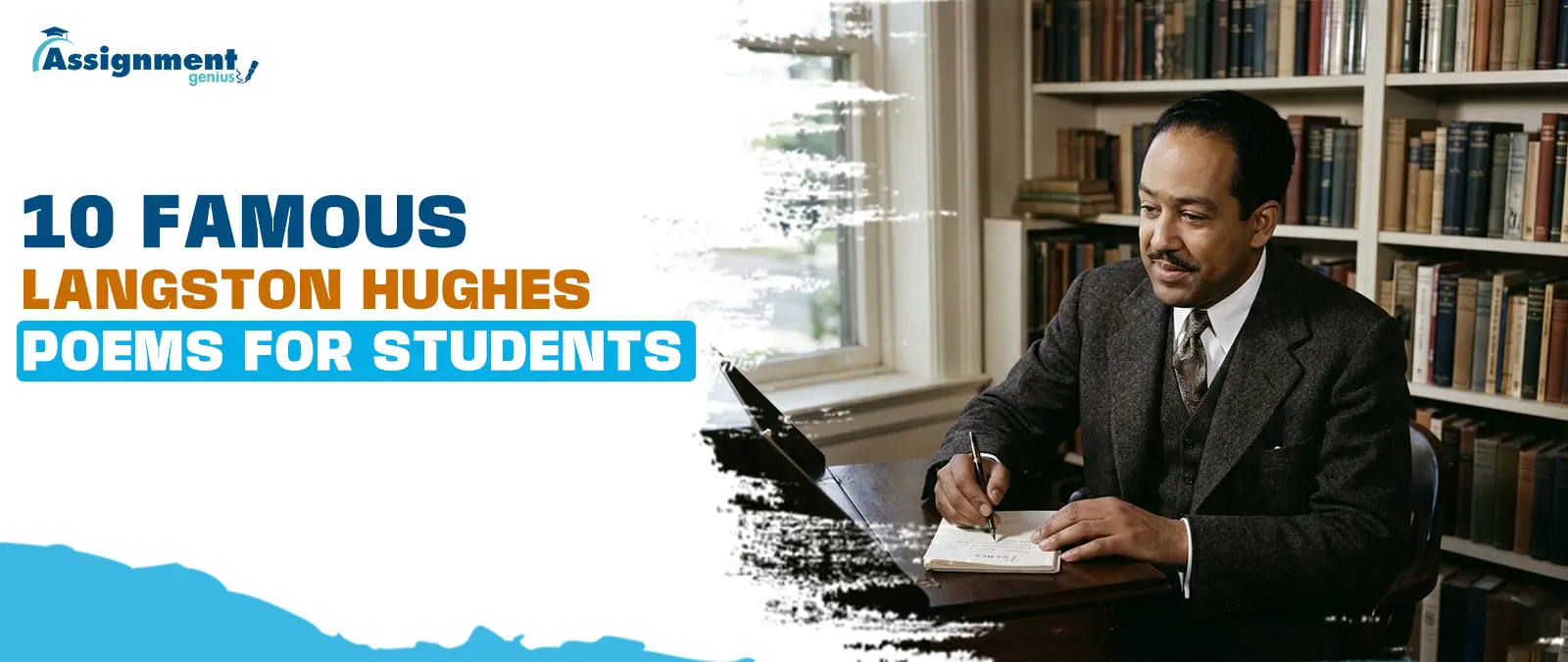
One of the most remembered and important poets in American literature is none other than Langston Hughes. The key topics such as race, identity, dreams and equality are explored by him in his poem in clear yet in an most powerful way that the readers can even connect with them today. People were motivated to think deeply about the society and their existence in it with the help of his writing. Generations of readers has been inspired by his work. Students relate with his poetry easily because they were about real emotions and life experiences. Top 10 most famous Langston Hughes poems that students should read are covered in this blog.
Who Was Langston Hughes?
To appreciate his prolific work, first it's helpful to begin at the beginning and learn about the poet. Langston Hughes was not only a poet he was first of all a storyteller, a social critic, a lover of jazz and a voice for others whose voice was not heard. The experiences of his life influenced his writing, and thus made his poetry deeply personal and universal in its power.
Early Life and Background
James Mercer Langston Hughes was born on February 1, 1901 in Joplin, Missouri. He grew up with his grandmother after his parents separating, and he was early captivated of the reading and storytelling. He had started writing poetry and was already an elected class poet by high school in Cleveland. One of the Langston Hughes poems from this period already exhibited his directness, his emotional honesty, that would characterize his career as a whole.
The Harlem Renaissance and His Rise to Fame
Elsewhere Hughes found his home after attending Columbia University, in Harlem. The Harlem Renaissance was a cultural way-burst - a bloom of Black art, music and literary culture. Hughes was an important figure in it. In 1926, he wrote and published his first collection, The Weary Blues, and poems by Hughes were read all over the United States almost immediately.
His Voice, Style, and Legacy
It was his employment of every-day Black American speech, the "blues rhythms" and "jazz cadences" as well as the euphemistic slang of working class people that separated Hughes from others. It is the musical, the poetic aspect of Harlem Renaissance Langston Hughes poems which make them memorable to students today. He died on 22 May 1967, but has left a legacy. His poems are still taught in schools around the world, and continue to resonate with readers about deep emotions and political truths.
Why Students Still Read Langston Hughes Poems Today?
Although he passed away decades ago, Hughes continues today to be one of the most taught poets in American schools, where he is taught in middle, high school and college classrooms. His words have a timeless quality to them which resonate with young readers from all backgrounds.
Themes of Equality and Justice
Students are drawn to langston hughes famous poems because they are the poems of justice and equality. Hughes was a writer during the era in which racial discrimination was legally accepted in America. He turned his anger, sadness and hope into reading, poetry that needed to be read. Today's students live in an era where issues of race and fairness are still raw and confronting, and thus the themes are more startlingly relevant.
Accessible Poetic Language
Famous poems written by Langston Hughes have a clear message. His writing was plain and in a rhythm that mimics real people's thoughts and speech. This accessibility isn't easy-musing; there is a richness deeply secret in the apparent simplicity of the poems. Students instantly relate to one another, and from this relationship arises an in-depth analysis.
Cultural Significance
In terms of American writing lore, Hughes' name is unsavory, yet unforgettable. Langston hughes famous poems are cultural documents which capture the hopes and struggles of an entire community. Teachers engage them as starting points for discussions on topics such as the Harlem Renaissance, the Civil Rights movement and the lives of people of African Descent - which are crucial topics in the study of American history.
Emotional Impact on Readers
Most importantly, poems by Langston Hughes move people, probably. His writing communicates deep emotions as he speaks about deferred dreams, the sacrifices of a mother, the desire for a just America. Poetry can be dry for some and Hughes is a poet who speaks to the student's heart, and by so doing, makes the reading assignment stick.
1. “Dreams” by Langston Hughes
This short, but highly moving poem is and has been popular with many pupils in elementary through junior high schools and is a favourite among teenagers. He has the power to pack a message in 8 lines that will stick with readers for a lifetime.
Summary of "Dreams"
In the Langston Hughes poem Dreams people should not give up on their dreams! Through the metaphors “broken-winged bird” and “field of barren frozen ground”, Hughes is making comparisons of the absence of dreams in a person's life. Assertions are made in both the beginning and the end of the poem, in a mirror-like structure with the briefness and the large emotional charge presented in two different images.
Main Themes in the Poem
One of the main ideas the Langston Hughes poem dreams is that hope and ambition are essential. Hughes proposes that dreams are not about luxuries, but necessities. If they are not there, Life is without content and stagnant. When dreams are denied due to systemic barriers, they must be clung to as a form of resistance in the life of African American people.
Why Students Love This Poem
Students feel they can relate to the dreams poem by Langston Hughes because it was a universal message. All have experienced nurturing a dream. It is easy to read on the first reading, but sufficiently complex to lend itself to intensive study. It is one of the very few words in which many meanings can be made and is frequently employed as an opening lesson in poetry analysis.
2. “Harlem” by Langston Hughes
Also known as "A Dream Deferred," "Harlem" is one of Langston Hughes greatest poems and most discussed poems in all of American literature. It was written in 1951 to explore the effects of dreams when they are postponed by forces beyond the student's control.
What Is "A Dream Deferred"?
The theme of Harlem, by Langston Hughes, revolves around the question "What happens to a dream deferred?". Hughes doesn't directly respond. Rather, he draws ever grander analogies: Does the dream turn as dry as a raisin in the sun? Does it fester like a sore? Does it droop when given a load? The last part of the line plunges the reader with a warning: "Or does it explode?
Important Literary Devices
The Harlem Langston Hughes poem is an example of a master of the similes and the rhetorical questions. All comparisons (like a raisin, like a festering sore, like rotten meat), lead to decay, pain. The repeated questions create an increasing tension that culminates in that explosive final line, which is isolated and emphasized by all of the above marks.
Message Behind the Poem
The message of Harlem by Langston Hughes is very political in nature. At its surface is a story of the psychological reactions that occur when a dream is denied. On a more profound level, it is an alarm call that the denial of a nation's rights has built-in repercussions. The meaning of “explode” has been variously figured as a straightforward allusion to the social convulsions to come in the coming decades.
3. “I, Too” by Langston Hughes
I, too" is a silent defiant and magnificent piece of poetry. It was written in 1924 or 1925 and it is one of the strongest affirmations of the humanity and belonging of black Americans in all American literature.
Summary and Meaning
The I, Too Langston Hughes poem begins with a bang: "I, too, sing America. This is direct reaction to the poem of Walt Whitman which extolled American workers, ignoring African Americans. The speaker is sent to eat in the kitchen when there's guests there, yet he eats and becomes strong, and looking forward to the day when there is no one who will dare to say to him, "Go away, eat your meals in the kitchen!" It concludes rather elegantly with ‘I am America, too…’
Themes of Equality and Identity
Then Langston Hughes penned I, Too, which is laced with messages of equality, strength, and pride in the nation. The speaker is not angry—rather, he takes his lot and stands staunchly for the harsher times ahead. It's so patient, so sure: an affectation that can provoke significant questions surrounding who has the right to keep defining America.
Analysis for Students
When reading the poem, I, Too by Langston Hughes, some elements reward close analysis by the student working on the poem. The simple, familiar environment of the home is packed with symbolic significance: kitchen vs table. The kitchen is an area of the margins of the society, the table is full participation in American life. The poem is free verse, reflecting the speaker's desire for freedom and his/her right to make his/her own choices.
4. “Mother to Son” by Langston Hughes
The relationship between a parent and a child is well expressed in a few cases, one of which is "Mother to Son. It was an original written in 1922 containing a mother's first hand advice on perseverance in the face of hardship for her son.
Meaning of the Staircase Symbolism
The main metaphor for the mother to son Hughes poem is the staircase. The mother tells her son that life has not been no crystal stair—one which had tacks and splinters and dark landings. It is a staircase symbolizing the path of life, with all its bumps and challenges. Despite it all, she climbs and climbs. The image is instantly comprehensible but with a massive emotional impact.
Life Lessons in the Poem
Langston Hughes' poem, "Mother to son", is a tale of staying strong. What the mom wants to convey: "Don't turn back, don't fall, don't sit down along the steps. This advice echo's the African American experience as they demonstrate perseverance despite the system oppressing them, teach their students about persistence and wisdom from elders, and ensure students' march forward continues.
Why It Is Popular in Schools
The subject matter and its conversational, dialect-rich style make ‘Mother to Son' a favourite in classrooms. The extended staircase metaphor is simple to comprehend and to break down into its constituent parts. This is used in the classroom to begin writing poems in dialect and the extended metaphor and introduce the concept that poetry can portray actual human relationships with great depth.
5. The Weary Blues
The title poem of Hughes' first book of poems, “The Weary Blues,” is a classical work of Harlem Renaissance poetry. It's an image of a blues pianist, plonking late into the night in a Harlem bar, his song laced with soulful pathos, heartbreak, and tired surrender.
Key Themes and Why It Matters
The poet superimposes the description over the actual songs the musician sings, making the distinction between poetry and music appearance difficult. The healing of music, the burden of collective grief, and the profound artistry of African Americans are the subject of its themes. The artist sleeps “like a rock or a man that's dead”… an unsettling picture of deep emotional depleting. This poem is required reading for students pursuing a literature curriculum that include African American literature or Jazz poetry.
6. Let America Be America Again
This is one of Hughes' most ambitious poems of the 1930s, the time of the Great Depression, as he found himself contemplating the discrepancy between America's ideals and their experiences as Black Americans, Immigrants, and poor.
Overview and Political Context
The speaker's longing for the America that should have been is introduced at the start of the poem. But a parental voice intrudes: '(America never was America to me.) The inherent structure – aspiration undercut by the bitter reality – pervades throughout. Hughes recounts all those who have lost the dream of America and then reaches a hot promise to not give up on that dream. The following are the key elements to consider while reading this poem: parenthetical voice, cataloging of marginalised groups, and the overall message of being able to gain hope through struggle.
7. Theme for English B
Written in 1951, "Theme for English B" is one of best poems of Langston Hughes. It is written as a college essay review assignment, and examines race, identity and the nature of being an American from the perspective of a young Black student writing about himself.
Overview and Themes
The first line of the poem is an assignment by an instructor: Write a page about you. A 22-year-old black student tells his story as he made his way home through Harlem, questioning what is real on his and his white teacher's paths. This poem leaps to a conclusion before easing back into one, as it interrogates the difficult subject of America's "identity" without firm answers: "You are white — yet a part of me, as I am a part of you. This poem is extremely relatable and can pose questions for students who are struggling with identity issues.
8. Life Is Fine
Many readers are a bit surprised by the dark humor and the ultimately defiant optimism of "Life Is Fine. The speaker attempts to kill himself twice — by drowning and by leaping from a high building — but both times rescues himself, finding life worth living—as the song's title suggests.
Themes of Survival and Classroom Value
The overall tone of the poem is blues-inflected and ironic – finding lightness even amidst the dark moments. The word life can be repeated after the words "Life is fine! Fine as wine! Life is fine" is a bit of defiant gaity that cannot be contained by the harshness of despair. This dogged determination to survive has taken on heightened significance in the African American experience. This poem begins conversations about coping with the blues, resilience and the use of humor as a strategy.
9. "The Negro Speaks of Rivers"
The Negro Speaks of Rivers was written by Hughes at the age of seventeen, and is one of the most spectacular debut poems in American literature. It was published in 1921 in the NAACP's magazine, The Crisis, and declared an extraordinary voice.
Summary and Meaning
The poem is a journey through old rivers all through the world, the Euphrates, Congo river, the Nile, Mississippi river, and takes the Speaker's soul back to the origin of human civilization — Black identity. The repeated phrase “My soul has grown deep like the rivers” turns into a statement of deep historical anchoring. Hughes penned it down in a train that was crossing the Mississippi, he is reported to have done this as he was thinking about the history of African Americans and how slaves used to travel down the Mississippi River.
Why Students Should Read This Poem
This poem provides a poignant discussion with students about an identity beyond oppression rooted in history. No one else wrote as Hughes did with his sweeping imagery: ancient waters; pyramids; Abraham Lincoln staring down at the muddy Mississippi. It also gets credit for a careful examination of anaphora, the repeated phrase "I've known rivers" that accrues a sense of immense historical evidence. For many pupils, it is an enjoyable but mild and subtle challenge.
10. "Refugee in America"
The poem "Refugee in America" was written in 1943 and among the more emotionally focused of Hughes' – only 12 lines, but an overwhelming measure of longing, pain, and defiant love of freedom.
Summary and Meaning
“Freedom” and “liberty” are the two words that are meditated upon in the poem. When his ears hear these words, the tears fill his eyes, his throat grows tight… for him, these words have a grievance that others don't feel. They are a desire that has not been completely realized. The title is eyebrow-raising enough—the refugee is one who is "away from what he belongs"-and Hughes wields the term for African-Americans in what was supposed to be their own country.
Why Students Should Read This Poem
One of Hughes's most pedagogically instructive and profoundly moving poems, “Refugee in America.” It is very short, thus it well serves some close reading exercises – every word is justified! The emotional logic of the era of civil rights will be compelling to students who are learning about it. The poem also invites an array of classroom conversations about the nature of language, the meaning of freedom, and the meaning of liberty—and that these are radically different things depending on who is speaking and what their life experience has been. This poem is an integral and profoundly moving component of Hughes' previously mentioned political poetry for anyone undertaking an analysis of it.
Common Themes Found in Langston Hughes Poems
No matter what the medium is, some common motifs recur throughout his body of work and with a persistence that is much like the refrain of a jazz tune.
Dreams and Aspiration
Langston Hughes poems on dreams are the core of his poems. Dreams are the heart and soul of his view, to be celebrated, deferred, lost or held on to. To dream was to demand one's humanity, to survive against oppression, to resist in fearless victory, and to express one's exceptional individual acts of resistance and survival courageously and continuously, like Hughes' did.
Identity, Justice, and Cultural Pride
Poems by Langston Hughes seems to flow and churn with issues of racial and national identity. Hughes's writing was consistent on the issues of racial justice and equal treatment. He was surprisingly jubilant, too,-the blues, the jazz, the streets of Harlem, the humor and the speech of Black people in general are proudly and lovingly present in his poetry. Langston Hughes poems of the Harlem Renaissance indelibly marked the African American cultural presence in America's art life.
Literary Devices Used in Langston Hughes Poetry
It is not merely what he says, but how he says it that makes Hughes' poetry endure. This helps students to engage in deeper learning when understanding these devices. This poem analysis essay guide is a great tool to follow to break down any poem.
For the analysis of the poem I, Too by Langston Hughes, begin with searching the imagery of the poem—the kitchen, the table, the coming company-because all these elements, in a symbolic way, activate an amazing amount of depth in the poem.
Imagery
Hughes spoke about raisins drying in the sun, ‘crystal stairs’, birds with broken wings — material sensoriments followed by emotional, and eventually logical, connections. This is characteristic of quality poetry, and can be reproduced by studying poetry in direct ways.
Repetition
Repetition is at the heart of Hughes' style, which is informed by the genres of blues and gospel music. In the poem Mother to Son the reference to a crystal stair is emphasized for cumulative effect. The repetition of rhetorical questions creates growing tension in "Harlem". Students learn that the use of repetition helps to build rhythm, emphasis, and emotional impact in Langston Hughes short poems.
Metaphor and Symbolism
Each of the pieces in "Mother to Son," "I, Too," and "Dreams" serves to symbolize more than it literally contains: the staircase is a symbolic roadmap for life, the kitchen a symbol of promise and history, the dream a metaphor of hope. Hughes offers some of the best and most lucrative examples of symbolism accessible in poetry, rather that obscure, accessible yet moving in meaning.
Rhythm and Jazz Influence
His distinct style is characterized by an easy, syncopated melody, inspired by jazz and blues. His poems don't step to the music; they swing and sway. Hughes was one of the pioneers in incorporating the rhythms and melodies of black America's music into poetry, forever altering the sounds of American poetry in the process.
How Students Can Analyze Langston Hughes Poems Easily?
Hughes' writing is perfectly suited to the development of analytical skills - manageable, yet challenging and rewarding. Students can easily analyze by keeping in mind the below mentioned things:
Identify the Theme First
Identify the main message, then move on to key ideas. There is a clear theme usually present in most Langston Hughes poems: dreams, justice, identity, resilience, etc. Read the poem, and ask yourself what this poem means and why it matters. If you have a really solid understanding of theme, you have a basis for any other details.
Study Poetic Devices
Recognize the means of Hughes's theme communication. Which image(s) does he use? Is there repetition? What are the meanings of the metaphors? For students working on a poem analysis essay, this guide for eventful poetry writing for complete beginner will likewise offer you concept of how it functions from the inside-out.
Understand Historical Context
Langston Hughes' poems always have an historical significance. The knowledge when it was written and what was going on in the USA, enhances understanding greatly. Hughes's writing was not done in isolation, it was all a reaction to what was happening all around him.
Read Aloud and Annotate
Never miss reading out loud. By trying to draw on musical traditions, Hughes' poems show something more when spoken. Be sure to listen for rhythm, pauses and particularly where the language becomes more musical. Then annotate – highlight the important line(s), identify questions, make connections. This is an active engagement which enriches the analysis and adds a personal touch.
Final Thoughts on Langston Hughes’ Most Famous Poems
Poems written by Langston Hughes are as meaningful today as they were at the times when they were first written by him. Core values which people still care about today such as respect, fairness, beauty and hope were the things that his works talked about. His poems are far more than something to study in class for the students. Remaining strong, chasing dreams and believing in yourself when there are difficult situations are the core important lessons that are being taught by his poems. The voice of one of the most talented and influential writers is heard when you read the poems written by Langston Hughes.
Frequently Asked Questions
What is Langston Hughes’ most famous poem?
One of his most popular poems, also known as "A Dream Deferred," is called "Harlem. The main question of its, "What happens to a dream deferred?," is one of the most commonly cited lines in the history of American poetry.
Why are Langston Hughes poems important?
During a particularly troubling period of great racial inequality, Langston Hughes' poems would reflect the experience of the African American people with literary artistry and social urgency. These are weapons that will continue to be used in classrooms around the world to discuss issues of race and justice, as well as identity and resilience.
What themes are common in Langston Hughes poems?
Common subjects are deferred dreams, struggles for racial equality and justice, identity and pride as African Americans, resilience in the face of adversity, and Harlem and the cultural diversity of black life.
Which Langston Hughes poem is best for students?
The first two are "Dreams" and "Mother to Son". They both go over each of the universal messages—hope, trying, and doing not to give up and not let any dreams go - with clear language and powerful metaphors.

Related Posts
-
 Feb 28, 2025David Warner
Best Site for Solving Accounting Problems
Find the best websites for solving accounting problems. Get expert help with assignments, solutions, and step-by-step accounting guidance.
Read More
-
 Feb 28, 2025David Warner
Reasons a Nurse Aide Might Decline an Assignment
Learn the valid reasons a nurse aide or CNA might decline an assignment. Explore ethical, legal, and professional considerations.
Read More
-
 Feb 28, 2025Nila Allen
What Does a Supply Chain Manager Do? Career Guide
Explore what a supply chain manager does, their roles, responsibilities, required skills, and career path in logistics and management.
Read More
-
 Aug 13, 2026Nila Allen
How to Write a Physics Assignment: A Complete Step-By-Step Guide
Learn how to write a winning physics assignment. Get expert tips on solving complex equations, structuring lab reports, and avoiding common student errors.
Read More