 USA
USA France
 Spain
Spain
APA vs. MLA: Which Citation Style Should You Use?
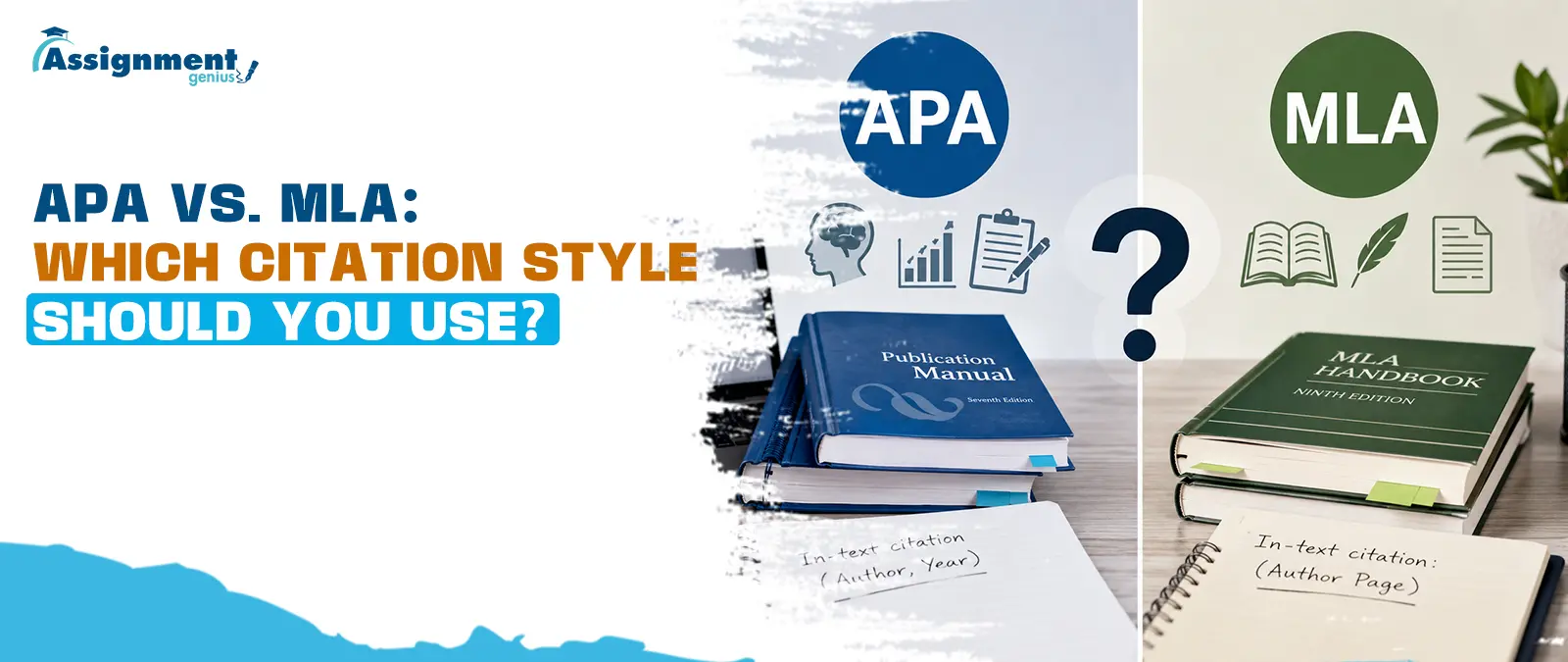
When project guidelines simply written cite your sources, confusion often follows. And in the state, you know that either APA or MLA would be the right fit. Here is the correct way to do it through the solution key. Apply APA format in case your field is psychology, education, nursing, business or any other social sciences. However, MLA format should be applied in case your field of study falls under English, literature or any other humanities discipline.
But choosing a format is only half the work. And this is why this guide is exactly built to explain why the rules exist in the first place. To summarize, when the guide draws towards its end, you will have a clear idea of Truth is APA format and MLA format aim to serve two different purposes, because of this the reason why various formatting rules are there.
What is the Purpose of APA and MLA Citation Formats?
APA is currently in its 7th edition, and the style is inspired from the Publication Manual of the American Psychological Association.. These are dynamic fields that change constantly, so the publication year appears in each and every citation created with APA format, because this is what it is all about.
MLA, on the other hand, is at its 9th edition now, and it is created by the Modern Language Association.. English departments work differently. You're not tracking how recent a scholar's opinion is. You're pointing at one specific line in one specific text and saying, look here, this is the evidence. So MLA cares about the page number and barely mentions the year at all.
One question, one answer, in a sense. APA: when was this said? MLA: where exactly do I find it? Everything else in both styles just follows from that.
How to Choose the Right Citation Style for Your Field
| Field of Study | Typical Style |
| Psychology, sociology, social work | APA |
| Education, nursing, public health | APA |
| Business, marketing, economics | APA, sometimes Chicago |
| English, literature, drama | MLA |
| Philosophy, film studies, cultural studies | MLA |
| History, fine arts | Usually Chicago, sometimes either |
| Engineering, computer science | IEEE or APA, program dependent |
Not sure which bucket your class falls into? Email your professor. One line. "Which citation style do you want for this paper?" Takes thirty seconds to send. I've watched students spend an entire evening reformatting a bibliography they could've avoided just by asking that question in week one.
APA vs. MLA In-Text Citations Explained
This is where both styles really diverge in practice from each other. Let us take for example a book written by John Smith which was published in the year 2023. Your idea is mentioned on page 45.
| Authors | APA | MLA |
| One author | (Smith, 2023, p. 45) | (Smith 45) |
| Two authors | (Smith & Jones, 2023, p. 45) | (Smith and Jones 45) |
| Three or more | (Smith et al., 2023, p. 45) | (Smith et al. 45) |
Look at what got left out of the MLA version. No year. Not an oversight. MLA just doesn't think the year is the useful detail here, so it drops it entirely and gets straight to the page.
Two extra rules worth knowing cold:
- No page numbers on the source, like most websites? APA drops the page and just uses (Smith, 2023). MLA still tries to point somewhere, often a paragraph number if the site has one.
- Quoting word for word always needs a page number in both styles. Paraphrasing sometimes doesn't. Quoting always does.
APA References vs. MLA Works Cited: Key Differences
APA calls its source list "References." MLA calls it "Works Cited." Different name, and the entries underneath look almost nothing alike once you set them side by side.
APA: Smith, J. (2023). Understanding climate change. Oxford University Press.
MLA: Smith, John. Understanding Climate Change. Oxford University Press, 2023.
| Element | APA | MLA |
| Author name | Last name, first initial | Last name, full first name |
| Title capitalization | Sentence case | Title case |
| Publication year | Right after the author's name | Near the end of the entry |
| DOI or URL | No period at the end | Period at the end |
That DOI row seems like nothing. It isn't. I've seen entire APA bibliographies with a stray period after every single link, copied straight from an MLA habit. Small mistake, but a grader who knows both styles will catch it in about two seconds.
Paper Formatting Differences: Title Page, Headers, and Spacing
Citations aren't the only thing that shifts. The page itself does too.
| Element | APA | MLA |
| Title page | Required, separate page | Not required, header instead |
| First page header | Page number only for students | Last name and page number |
| Running head | Optional for students, required for publication | Doesn't exist in MLA |
| Font | 12pt Times New Roman or similar | 12pt Times New Roman |
| Margins | 1 inch, all sides | 1 inch, all sides |
| Spacing | Double throughout | Double throughout |
The title page mix-up is the one I see constantly. Five MLA papers in a row, then an APA assignment shows up, and the student's hands just default to habit. No title page. It's an easy fix. It's also an easy way to lose points on a paper where the actual argument was solid.
Rules for Block Quotes in APA and MLA
Most comparison articles skip this completely, and it costs students more points than almost anything else on this list.
Quote something long enough, and both styles want it pulled out of your paragraph entirely. No quotation marks. Indented on its own. The threshold for "long enough" is where they split.
- APA: 40 words or more triggers a block quote.
- MLA: Four rows of prose or three rows of verse
Now for the clinching, most people do not pay attention to them when talking about block quotes. The parenthetical citation in a block quote is placed after the end of the block and not before the period. If you do it wrong, you end up with a 45-word quote in an inline quote.
Clean, avoidable deduction, especially in APA.
Citing Websites and Journal Articles in APA and MLA
Books are the easy example. Most actual student papers lean harder on journal articles and websites, where the formatting gets less obvious.
Journal article, both ways:
APA: Lee, K. (2022). Climate anxiety among college students. Journal of Environmental Psychology, 45(3), 210 to 225.
MLA: Lee, Kevin. "Climate Anxiety Among College Students." Journal of Environmental Psychology, vol. 45, no. 3, 2022, pp. 210 to 225.
MLA wraps the article title in quotation marks and title-cases it. APA leaves it in plain sentence case with no quotation marks at all. Small difference, easy to miss, checked constantly by graders who know what they're looking for.
Website with no listed author:
APA: Centers for Disease Control and Prevention. (2023). Understanding vaccine safety. "www.cdc.gov"
MLA: "Understanding Vaccine Safety." Centers for Disease Control and Prevention, 2023, "www.cdc.gov."
No individual author on the page? The organization becomes the author. Feels odd writing "Centers for Disease Control and Prevention" where a name usually goes. It's standard. Not a workaround, not a mistake, just how both styles handle it.
Narrative vs. Parenthetical Citations Explained
This is something that a lot of guides don't bother with, but it works for both styles. It may be possible to replace the "author" name in the sentence with just the parentheses. That's parenthetic: In recent studies, it has been suggested that screen time has an impact on sleep quality (Smith, 2023, p. 45).
At times, you rather insert the author's name into your sentence. This is a narrative, as Smith (2023) reported that screen time has an impact on sleep quality (p. 45).
Both are not "good" solutions. Good papers use both, as needed for the sentence. When the researcher is an important figure to the story, such as a well-known area researcher, use the narrative form. When the finding is more important than the person who made the discovery, lean on parenthetical. If a paper does one thing or the other in every instance, it begins to feel repetitive right away, and that is a pretty easy clue that a paper wasn't revised.
Why You Should Avoid Online Citation Generators
Everyone uses one eventually. They're also wrong more often than students assume.
Where they mess up, specifically:
- Default to the wrong edition unless you manually pick APA 7th or MLA 9th
- Botch the "et al." rule constantly once a source has three or more authors
- Drop italics or quotation marks when pasting a title straight off a webpage
- Leave a blank instead of flagging a missing page range or date
Treat the output as a rough draft, not a finished product. Check it against the actual rules, especially for anything that isn't a plain single-author book.
Why Proper Academic Citation Matters
We might easily dismiss it as something to do with commas and the professor's interest in commas over the argument. It has a very real cause, however. Using a citation enables someone else to follow up your claim to its source and compare it with the original. That is the whole point of making academic writing credible!
It's with you on your way back through the class, too. Submit a writing sample for acceptance to graduate school, and evaluate it based on how you use sources. Go do research, journalism or policy research and the discipline of citation will be ingrained into every report you write. To get it right this time is better than to white-knuckle it over the next four years to every deadline.
Quoting vs. Paraphrasing: When to Include Page Numbers
It is a common mistake made by students to think that paraphrasing means that they do not need to cite an author. It doesn't, in either style. Even if you have paraphrased the idea, statistic or analysis, it should be cited if it comes from another source.
The only difference between quoting and paraphrasing is the page number, and in certain situations.
- Always include a page number when you quote directly – even in APA format.
- While APA will not mandate it, it is a good idea to provide a page number when paraphrasing a specific claim from a uniquely identifiable page.
- Normally, paraphrasing a general idea that covers an entire article, chapter or book will only need the author's name plus the year (APA style).
- No page number.No page numbers (MLA)
If a reader would have to go to one precise page to check your statement, you should mention the page number (this test is more or less applicable). Don't pretend that it's on one page just because you have to follow a rule.
How to Format Hanging Indents and Alphabetical Source Lists
There's one formatting element that is the same in both types of styles, and it's an important one to mention, since many students will make the error in Word without knowing it. All items in your reference list/Works Cited will be hanging indents. First line of each entry is indented. All lines then run in a ½" in. indentation.
Both styles also include an alphabetical list of sources with the "last name of the source". If there is no author, alphabetize by the first major word of the title, (such as 'The' or 'A' are ignored). Organizations are also authors, so the CDC source is alphabetized, not somewhere random based on the page title, which is an O source.
Once you know where the hanging indent setting is located – highlight your source list, open the paragraph formatting menu, and set the “indent” to “hanging” – it's only a matter of seconds to get the hanging indent right in Word. One of the most frequent causes of what looks like sloppy papers, even though they are heavily cited, is that the students neglect to keep up the citations throughout the paper.
Common Citation Mistakes That Cost You Points
Not every slip weighs the same with a grader.
| Mistake | Typical Impact |
| Mixing APA and MLA in one paper | High, looks careless across the whole document |
| Citation with no matching source list entry | High, reads as unverifiable sourcing |
| Wrong capitalization in the reference list | Low to moderate, usually a small deduction |
| Missing page number on a direct quote | Moderate, looks like an unverified quote |
| Outdated edition, APA 6th or MLA 8th | Moderate, depends how strict the professor is |
| Wrong block quote threshold | Low, mostly a formatting note |
Short on time before a deadline? Fix the top two first. A slightly off indent won't tank a grade. A citation with no matching entry in your bibliography absolutely can.
Step-by-Step Guide to Switching Citation Styles Quickly
MLA paper due Monday, APA paper due Wednesday, two different classes. It happens constantly. Here's a sequence that actually saves time instead of relying on memory.
- Check the assignment sheet. The style is almost always stated there.
- Confirm the edition. Old versions are still floating around online everywhere.
- Build a fresh header or title page for the style you're using. Don't edit a leftover.
- Convert every in-text citation one at a time. Author-date and author-page aren't a find-and-replace job.
- Rebuild the source list from scratch in the new style's punctuation.
- Do one pass focused only on citations, separate from the pass focused on your actual argument.
Final Thoughts
Now it has been cleared that neither style is inherently superior; each answers a different question. APA asks you to keep track of the age of your sources. MLA asks you to be precise about where ideas appear within a work. As long as this distinction is truly understood, the differences in punctuation become meaningful in terms of using the right tool for the job.
Review assignment directions before writing any citations. Make sure you’re using the appropriate style for your field if no other style is specifically indicated. It's better to leave your Works Cited or bibliography list open in a new window so you can copy and paste the citations on the night of the paper deadline than to try and remember them all.
Frequently Asked Questions About APA vs. MLA
Is APA or MLA easier to learn?
MLA usually clicks faster since there's no title page and fewer layered rules to juggle. APA takes a bit longer at first, mostly the heading levels and stricter reference punctuation, but it becomes automatic after a paper or two.
Can I mix APA and MLA in one paper?
No. Pick one and stick with it across every citation and every formatting choice. Mixing styles is one of the fastest ways to lose points, even when each individual citation is technically fine
What if my professor never names a style?
Default to whatever's standard in your field, then confirm with a quick message before you get too far into the writing.
Do both styles require a source list?
Yes. Every in-text citation needs a matching entry there, and every entry needs to show up somewhere in the actual paper. No orphans either direction.