 USA
USA France
 Spain
Spain
How to Show Line Breaks in Poetry When Quoting?
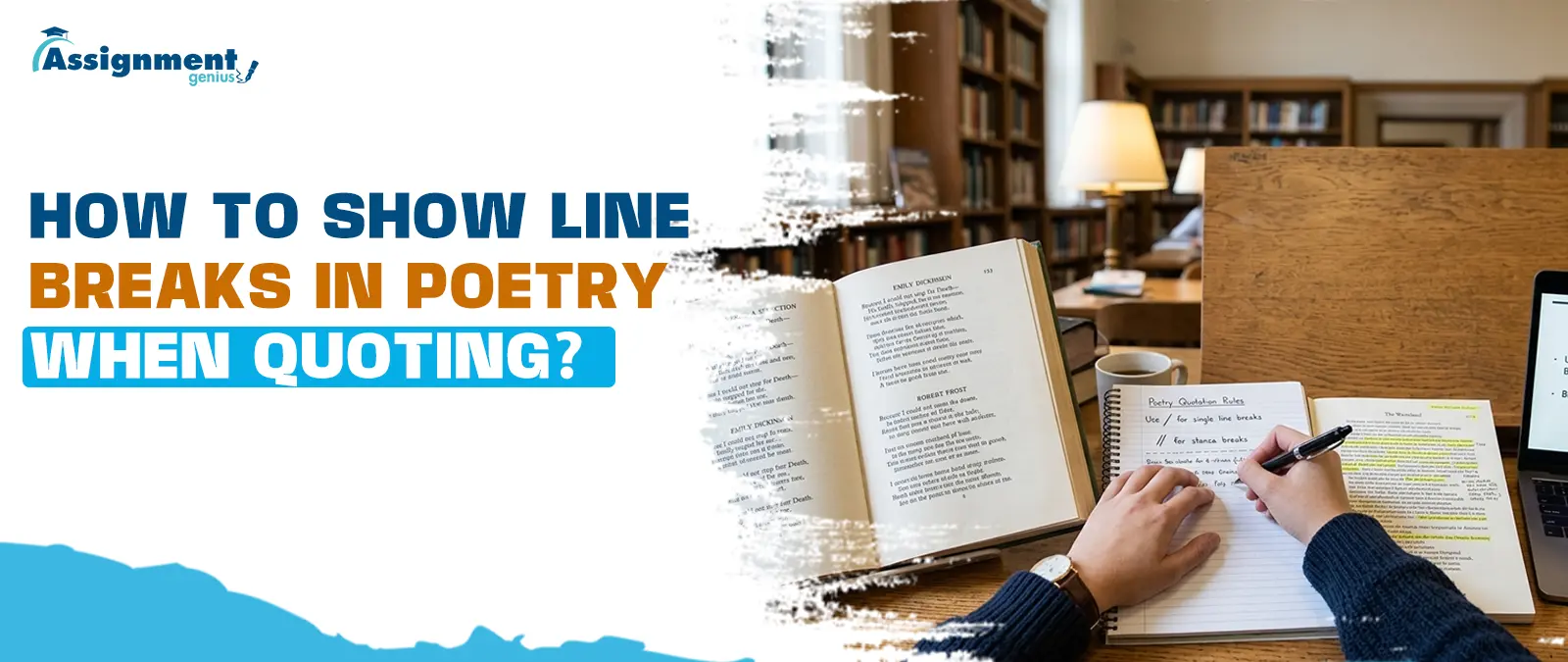
Poetry is not prose. It breathes rather than speaks and pauses purposefully and speaks through its white space as much as through its words. If you quote a poem in an essay, research paper or blog; you don't have a choice in the matter regarding the line breaks. It's about accuracy. A quotation of a poem with no line breaks is a different thing all together; it is a misrepresentation of the original.
In this detailed guide you will learn each everything like what lines breaks is, what’s their importance, MLA formatting rules and the common mistakes that are done by students mostly.
What Are Line Breaks in Poetry?
You need to have a clear knowledge of what you are going to work with before you start quoting a poem. So what is a line break in poetry exactly?
A line break is the place at the end of a line in a poem that is followed by a new line. Poems break the lines as deliberate artistic devices, as opposed to prose, in which there are no line breaks (no stopping points) unless they occur at a grammatical stopping point. At the basic level, the definition of line break for a poem is the end of a line in a poem, as determined by the poet's choice rather than the end of a line in a page or the rules of grammar.
To define line break in poetry more specific: It is a stylistic and structural tool that determines the pause and the place where the reader's eye falls, where the breath is drawn and how the meaning is conveyed from one word to another. This is an important difference between a sentence break and this:
- Sentence break is grammatical; stops when the thought is complete.
- Poetic line breaks can be used anywhere in the line, as anywhere in the sentence, and even in the middle of a word, depending on what the poet wants to do.
Line breaks are used for many reasons by poets:
- To set or break rhythm/meter
- To create or release stress and strain
- To highlight one word or image.
- To pace the reader and keep him or her breathing evenly
- To make patterns/arrangements on the page to support meaning
The line break meaning in poetry is thus a structural and psychological nature. Determines the effect of a poem on the page, how it sounds when read aloud and how the reader might read each image or idea.
For more inspiration on how poets use and create Line Breaks, take a look at our Line Breaks in Poetry guide.
Why Line Breaks Matter When Quoting Poetry?
When someone asks what is the purpose of line breaks in poetry the answer has several dimensions.
- Rhythm and Pacing: They affect the speed of a poem. A short line produces a rapid beat, a long line extends the length of time. You remove the poet's rhythm by eliminating these breaks and misrepresent the poet to your reader.
- Emotional Pauses: A line break can serve as a pause, like a breath. It makes the reader stop, to sit before a word and/or an image, and to go forward. The effect of line breaks in poetry is partly emotional they allow certain words to be more important, just by being put at the end of a line where the eye rests for a few moments.
- Visual Structure: Poem is also a visual art. Lines are aligned in a meaningful way on the page. Those lines are collapsed into a prose like paragraph without notation; you lose the visual architecture designed by the poet.
- Academic Integrity: In academic writing, stealing someone's poetry words means that you are careless. Not setting the text as the original even in a short quote; weakens your credibility as a reader and interpreter of the text.
Consider this example. If you are about to quote the following two lines from William Carlos Williams:
so much depends
Upon
You would have changed the poem if you wrote: "so much depends upon" without the line break. That pause following "depends" isn't a mere pause, but a moment that slows down the reader, disrupts the topic and serves as a moment of anticipation that is essential to the effect of the poem. Take it and the meaning changes.
Understanding Poetry Formatting Before You Quote
Before you quote any poem, please read the poem and pay attention to how it is set out on the page. Notice the following:
- Where do each of the lines start and end?
- Do the lines break up into stanzas (blank lines between sets of lines)?
- Are there punctuation at the end of lines or do lines end without punctuation?
- Is there anything that is unusual in terms of indentations or patterns?
It is not just to say these details aren't ornamental. They are an integral aspect of the meaning of the poem. If poetry passages are to be used in academic writing, the purpose is to retain these qualities to the extent possible within the context. There are two main ways of doing this, each of which has rules, especially with MLA style: block quotation and inline quotation with slashes.
MLA Rules for Quoting Poetry Line Breaks
The style used while quoting the poetry is MLA. Having a clear knowledge of how to cite line breaks in poetry using the MLA format heading and header is very important skill that students have to learn when writing a essay and research paper.
Quoting Three Lines or Fewer (Inline Quotation)
When you do quotation for lines that are less than 4 within your text you try to integrate them into your prose but in this you show line breaks by using forward slash and you have a space on each side. This is the conventional way to show line breaks in a running sentence when writing poetry.
Example: Shakespeare writes, "Shall I compare thee to a summer's day? / Thou art more lovely and more temperate" (Sonnet 18, lines 1–2).
The slash denotes to the reader: "A new line started here in the original. Use double slash ( // ) to mark a break in the quotation, if it is used within the stanza. Having a knowledge of how to indicate a line break in poetry with the help of slashes may look as a small point but it is very important skill and many students do not remember.
Quoting Four Lines or More (Block Quotation)
If you use four or more lines of poetry, you need to use a block quotation. The way it works is:
- Use a colon as the introduction to the quotation.
- Double indent the entire quotation (one inch instead of the standard paragraph indent).
- Avoid putting any quotation marks in.
- Keep original line breaks.
- Put the citation (author, line numbers) at the end of the final line's punctuation.
Example:
O wild West Wind, thou breath of Autumn's being,
Thou, from whose unseen presence the leaves dead
Are driven, like ghosts from an enchanter fleeing,
Yellow, and black, and pale, and hectic red. (Shelley, lines 1–4)
No slashes are necessary in the above line breaks in poetry examples, since the line breaks are indicated visually with the formatting.
Punctuation Placement
Often, there is a question about the placement of the period. If using an in-line quotation with slashes, the period is after the parenthetical citation, not the last word of the poem. If you quote a poem, the period is at the end of the poem's punctuation, followed by the parenthetical citation.
Read our article on Four Basic Parts of an Essay to learn the basics of how to structure and cite an essay.
Common Examples of Line Breaks in Poetry
Line breaks in poetry can be used in a variety of different ways. Knowing these patterns will assist in the accurate reading of a poem and also in the faithful quotation of a poem. The line break examples in poetry that you will encounter are mentioned below in details.
End-Stopped Line Breaks
An end-stopped line is a line that ends with a grammatical pause (usually a punctuation mark, like a period, a comma, a semicolon, or a dash). The line should have an ending, where the thought naturally ends.
| Example from Alexander Pope's An Essay on Man: Know then thyself, presume not God to scan; |
Both lines are punctuated and both lines form a complete thought. These are evident examples of line breaks in poetry that indicate the full or partial pauses, similar to the breathing marks in music. Students tend to maintain the end-stopped line easier when using the punctuation in the quotation.
Enjambment in Poetry
Enjambment is the opposite of an end-stopped line. It is caused by a sentence or clause extending from line to line without the use of a grammatical pause. The line breaks have a forceful effect, pushing the reader to follow the text in the middle of a thought.
| Example from Keats' Endymion: A thing of beauty is a joy for ever: |
The word “never” at the end of the second line leaves the reader guessing, the sentence is not finished, he or she must keep reading. This is one of the most compelling example of a line break in poetry: the break becomes the vehicle for expression, and holds the reader in a state of anticipation until it resolves the thought on the next line.
The slash is particularly significant for lines that are enjambed when quoted in-line. If not, a reader cannot guess that the original poem was supposed to be broken across multiple lines.
Caesura and Internal Breaks
Caesura (from the Latin for "cutting") is a pause in a line of poetry, not at the end of the line. It is usually (not always) indicated by some form of punctuation in the middle of a line.
| Example from Alfred Lord Tennyson's Break, Break, Break: Break, break, break, |
The first line pauses at the position of the commas. This internal rhythm contributes to the repeated breaking of waves in the poem. When quoting caesurae are not marked with additional notation but it is important to maintain that punctuation that has been created as if they are removed it will change poem's musicality and meaning.
Common Mistakes Students Make While Quoting Poetry
Even students who grasp the concept of line break in poetry definition sometimes fail to get it right in the process of quoting poetry. Following are the most common issues and ways to avoid them.
Forgetting Slashes in Inline Quotations
This is the one most common error. Students may forget to use slashes in their quotations of two or three lines of a poem in a sentence. It appears as prose and the line break cannot be seen by the reader. Always use a forward slash with a space on each side ( / ) to show how to express line breaks in poetry in an inline quotation.
Pro Tip: As you type a line of poetry into your essay, ask yourself if you marked where each new line begins. If your quotation is more than one line long, and contains no slashes, then something is missing.
Removing or Changing Punctuation
Poets frequently finish a line with an unusual punctuation, or without any punctuation at all. Students may sometimes add commas or periods to these choices, or delete dashes that are confusing. This changes the rhythm and meaning. Always use the punctuation as it is used in the source.
Incorrect Indentation in Block Quotations
Spacing of one inch from left margin and indented one inch from right margin should be done in Block quotations. Formatting errors like incorrect indent or no indent at all will impact the how to do line breaks in poetry quotations in MLA.
Mixing APA and MLA Styles
For social sciences use APA; for literary analysis use MLA. They follow different citation conventions and students sometimes combine conventions, such as using APA citation (author-date) for a poem cited with MLA slash notation. Follow one set of guidelines throughout your paper.
Please note: Your instructor or assignment sheet will indicate which citation style to use. When in doubt, ask. A combination of styles implies that the person is not familiar with either.
Breaking Poem Structure in Block Quotations
Each and every line needs to be appeared on its own line in a exactly similar way as it is shown in source in a block quotation. Sometimes by mistake students merge two separate lines into a one combined line. Before submitting always compare your quotation with original source.
Pro Tip: Always count number of lines in your quotation and lines in the original sources when you have finished writing. They should match. If you are using slashes, count the slashes – there will be one less slash than number of lines being quoted.
Tips for Using Line Breaks in Your Own Poetry
In this guide, emphasis has been placed on quoting the work of other poets. When composing poetry having a understanding bof line breaks is very important. For improving the creating writing it is cruical to now have a look at how to use line breaks in poetry properly.
Break Lines for Emphasis
Giving single word or phrase its own which is isolating it emotionally and visually is one of the most effective uses of line break. Words receive more weightage when they stand alone in the end of line instead of they being combined in one sentence. Think of creative line breaks in poetry as a way of underscoring what matters most.
The negative will land with force if you write: "She waited for the answer / No. If there's no break, it's simply a sentence. This makes it an event.
Use Line Breaks to Control Rhythm
Each line break is a slight pause. You're deciding where your reader will breathe by breaking, you're creating the rhythm for your poem. Short lines create urgency or fragility. Long lines are expansive or overwhelming. Alternating can create contrast and momentum between them.
Read your peom aloud and identify youself where pauses occur naturally to have understanding of how to create line breaks in poetry properly.
Experiment With Visual Structure
Poems don't need to be of a fixed line length. Making shapes on pages, use of indentation to recommend hesitation and making use of varying length to mirror content are some kind of visual structures that are being used by many poets to convey the meaning. The page is just like a canvas as is the language.
Read our guide on How to Start Writing Poetry for more guidance on getting started with your own poetic practice.
Difference Between Line Breaks, Stanzas, and Enjambment
Many students get the meaning of related poetry terms tangled up because they all impact structure and pacing. Each, however, has a different function. The following is a brief comparison:
| Term | Definition | Function | Reader Impact |
| Line Break | A closing element of a poem | Held two pacing, rhythmic and emphatic control rallies. | Makes micro pauses; forms meaning in words |
| Stanza | A grouped set of lines, separated by white space | Organises ideas or scenes into units | Sends a paragraph in which there are larger structural gaps |
| Enjambment | When a sentence is extended without interruptions beyond its line breaks. | Builds up momentum and suspense | Draws the reader in and keeps him/her waiting for the solution |
To further elucidate the difference: In poetry, line and line break in poetry go together; each line ends with a line break. A stanza is a group of lines, a break in line of poetry is a pause that happens in the line and not at the end of the line.
When viewed as music a poem becomes more musical with longer lines containing resting places (i.e., line breaks). Each stanza may resemble a verse and/or chorus while enjambment represents a musical phrase that has no end before a new bar begins.
Best Practices for Academic Poetry Quotations
When it comes to quoting poetry in a scholarly paper, it's all about attention to detail. Here are the best practices for how to quote line breaks in poetry accurately and professionally.
- Always double check Your Quotes: It's important to read the source material and compare the quoted text. Identify and correct slashes that are missing, changed in order, and collapsed, as well as any capitalization that is not in the original. All errors matter; even minor ones.
- Use Line Numbers, Not Page Numbers: Line numbers are use in parenthetical citation when writing for poem and not page numbers. You can only use them when there is no other option.
- Keep the Original Formatting: If the poet has used unusual spacing, indenting, or capitalizing, keep it. It's not about style, it's about faithfully representing the author's work.
- Be Able to Indicate Line Break in Poetry in Different Contexts: The line break should be indicated with the slash in an inline quotation. Visual line breaks are used for a block quotation. Use slashes for short words or phrases in a footnote or caption. The practice is different depending on the situation, but the need to mark does not.
The ability to know how to show line breaks in poetry when quoting conveys the poet's meaning, enhances the trustworthiness of the academic work, and assists readers to experience the poem as the poet intended.
Final Thoughts on Line Breaks in Poetry
Anyone who is learning, analysing and writing a poetry it is very important for one to have a clear knowledge of line breaks. Rhythm is set, tempo is governed, meaning is improved and reader’s feelings are directed with the help of line breaks. To show your respect for the craft of poet and to improve your own value as a writer you should properly maintain your breaks properly in your quotation of poem.
Poetic structure is an important consideration to make when learning the formatting rules, when analysing enjambments or when experimenting with your own creative work, you will develop a greater appreciation for poetry and be able to express yourself more successfully.
At Assignmentsgenius offers a professional Assignment Writing Service for students needing expert academic support. Get high-quality, plagiarism-free assignments, timely delivery, affordable pricing, and assistance across multiple subjects from experienced academic writers dedicated to improving student performance and reducing academic stress.
Frequently Asked Questions
What is a line break in poetry?
Line break: a point where one line of the poem finishes and another one starts. Poets have freedom to use line breaks for rhythmic, emphatic, pacesetting and emotional effect, unlike prose. Line breaks influence the reader's experience of meaning, pauses, and sound in a poem.
How do you show line breaks when quoting poetry?
For short quotations (fewer than five lines), use a forward slash and spaces before and after the quotation, as in this example: “word / word.” Use a block quotation (four or more lines) and don't add slashes to the formatting of the poem.
Why are line breaks important in poetry?
Rhythm, pace, stress and feeling can all be influenced by using line breaks in a text. A line break also influences the reader's breath and where the reader focuses his/her attention, as well as the progression of ideas. Removing or altering line breaks from a work can have a significant effect on the meaning, tone and visual structure of that piece of writing. Thus, accurate quoting is vital to successful academic writing.
What is the difference between enjambment and a line break?
A line break is merely the end of a line of poetry. Enjambment occurs when there is no stopping or punctuation at the end of one line and the beginning of another. Poems do not necessarily have enjambment and all of the lines have to have line breaks.

Related Posts
-
 Feb 28, 2025Nila Allen
How to Cite Case Studies & Lab Manuals in APA
Struggling with tricky APA citations? Learn how to correctly cite case studies, lab manuals, and other unusual sources in APA 7th edition format.
Read More
-
 Apr 30, 2025Nila Allen
How to Cite a Case Study in APA Format -Step by Step Guide
Learn how to cite a case study in APA format with step-by-step examples. Avoid common mistakes & ensure proper citations.
Read More
-
 Jul 18, 2026David Warner
Master's Degree or Masters Degree? Correct Usage
Confused between master's degree and masters degree? Learn the correct usage, grammar rules, and examples to write accurately in 2026.
Read More
-
 Sep 29, 2026Michael Thompson
MLA Format Heading and Header Guide 2026
Learn MLA format heading and header rules with step-by-step examples, formatting tips, and student-friendly guidelines for academic papers.
Read More