 USA
USA France
 Spain
Spain
Study Burnout: Signs, Solutions, and How to Recover in 2026
Student burnout and young professional burnout are no longer fringe phenomena; it is a pervasive phenomena experienced by millions of people all over the world. According to recent statistics, burnout among younger generations occurs earlier than at any previous time, and the stress and exhaustion levels are at their maximum at the age of 25 because of the high intensity of performance, academic, and economic factors. It is a pattern that seems to have more systemic forces in it, with intense working conditions, followed by high digital hyperconnectivity and does not always reflect personal weakness or strength.
The guide will help you determine the signs of Study burnout, discover evidence-based strategies to how to recover in 2026, and cultivate the strength that will enable you to not only survive but also thrive in your education and beyond.
What Is Study Burnout?
Study Burnout refers to a combination of chronic physical, emotional, and mental exhaustion that happens due to long-term stress and pressure of the academic setting. It usually happens when students have excessive workloads, deadlines and expectations and they do not have the time to rest or have support. Academic burnout in college students lowers motivation, concentration, and grades, thus students get disconnected with their studies and as time passes feel overwhelmed with the learning requirements.
The Official Definition
According to the World Health Organization (WHO), burnout is defined in the International Classification of Diseases (ICD-11) as:
“A syndrome that is conceptualized as a consequence of chronic stress at the workplace that has not been effectively coped with.”
WHO describes burnout as having three dimensions:
- Sensations of burnout or exhaustion.
- Mental distancing to work or work-related negativism or cynicism.
- Less professional effectiveness.
Notably, WHO explains that burnout is an occupational phenomenon rather than a medical one and it is only work-related context. Nevertheless, numerous researchers and educators have come to the realization that student burnout symptoms occur in a very similar way, particularly during high-pressure academic settings.
Most of them misconstrued the daily stress as burnout. This table demonstrates clearly that burnout is more than the usual academic stress:
| Aspect | Everyday Stress | Burnout |
| Duration | Short-term, situational | Long-term, chronic |
| Energy level | Tired but recoverable | Constant exhaustion |
| Motivation | Still present | Severely reduced or absent |
| Recovery | Improves with rest | Persists despite breaks |
| Impact | Temporary performance dip | Ongoing emotional and academic decline |
Why Students Are at High Risk in 2026
Study burnout is more prevalent than ever before, and students, in particular, Gen Z, are under particular pressure. Most of them have hefty coursework and part-time jobs, internships, career preparation, and deal with economic insecurity and familial mounting student loan debt, all of which is a serious source of stress and anxiety. The psychological effect of this financial burden is shown by the fact that nearly six out of ten borrowers are anxious because of student debt.
Simultaneously, the digital culture of being always-on identifies no limits between study, work and life. Constant connectivity refers to the fact that classes, assignments, and notifications, as well as online learning platforms, maintain and sustain students at a constant level of engagement, eliminating downtime and exacerbating exhaustion.
It is also a myth that a quick vacation will cure burnout - since burnout is a consequence of sustained stress and systemic forces, and not merely a temporary fatigue. To deal with it, the workload, digital habits, and support systems have to be changed in a deeper way.
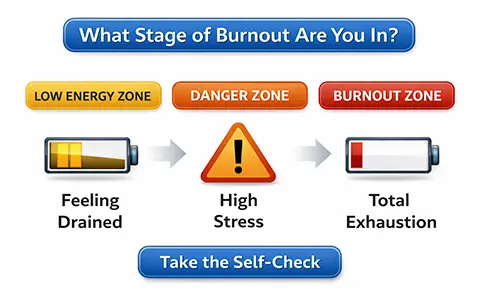
The 3-Stage Burnout Spectrum: Where Are You?
The signs of study burnout does not occur instantly. It is progressive and has distinct stages that have early signs. The realization of where you stand in this spectrum would make certain that the right response is promptly done to prevent additional overworking and formulating the right measures of recovery.
Stage 1: The Stress Overload (Early Warning Signs)
It is at this point that pressure starts to dominate recovery. The burnout from studying symptoms are you might always be tired even with enough sleep, easily irritated or may have problems falling or maintaining sleep. The level of concentration declines, although motivation exists. Most students ignore this stage as normal stress, but this phase is where burnout continues to develop. Workload, sleep, and boundaries can be adjusted early to prevent study burnout from taking hold.
Stage 2: The Cynicism Zone (Burnout Setting In)
In this case, emotional distance is generated. The student burnout symptoms indicate a lack of motivation, and research can feel meaningless or discouraging. You may fall behind more, miss classes or even be cynical about tasks and grades. Even work that you usually enjoy is exhausting. This is when one is an indication that the stress is no longer transient; it is becoming chronic. Productivity goes down, and burnout is magnified without intervention.
Stage 3: The Exhaustion Crisis (Full Burnout)
This is full burnout. The level of emotional and physical energy is reduced, it is extremely difficult to pay attention and even one job appears to be too much. Physical signs of study burnout: Headache, frequent illness, and stomach problems can be manifested. Hopelessness or detachment is very mainstream. Rest is not sufficient at this level, but systematic recovery, assistance, and transformations in the system are needed.
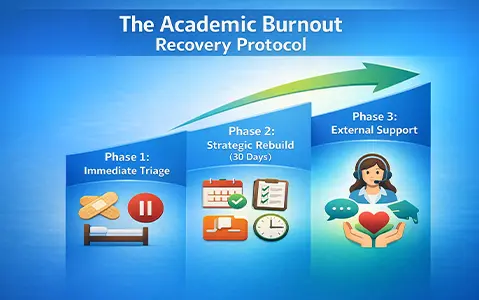
The Academic Burnout Recovery Protocol
Study burnout cannot be healed by mere motivation, but instead, a well-developed and sensitive system is needed. This recovery plan is structured so as to stabilize you initially, build sustainable studying habits subsequently, and lastly have you supported in the long term. Imagine it as a step-by-step process of how to recover from study burnout to stability and strength.
Phase 1: Immediate Triage – The “Stop the Bleeding” Week
This stage is concerned with short-term relief. Your productivity is no longer important when burnout kicks in: it is rather about preventing the additional harm. These activities will help in calming your nervous system, emptying your academic pressure system, and restoring your basic physical and mental health.
Action 1: The Mini-Reset
Take 2-3 days of actual rest and no academic work and guilt. And it is not procrastination, but it is recovery. In addition, screen time ought to be limited to basic necessity and should be done in the activities that offer the greatest pleasure and involve minimum energy as walking, listening to music, cooking or even spending time outside.
Action 2: The Permission Slip
The Study burnout in college victims in silence aggravate burnout. Write a concise, sincere note to professors or advisors, stating that you are experiencing academic stress that is related to health issues and asking for brief extensions. Flexibility is granted in most institutions, but upon request. Effective communication lessens the stress and gives much-needed time to recover.
Action 3: The Basic Health Audit
Burnout thrives on neglect. Go back to basics, normal sleep schedule, hydration and one balanced meal per day. That you must be stable, not perfect. Restoring these basics boosts concentration and emotional control, and vitality that creates a ground upon which deeper healing is created in the next stage.
Phase 2: Strategic Rebuild – The Next 30 Days
When it has settled down, then it is time to start over. This stage substitutes the burnout-induced habits with mechanisms that honor your energy and save your recovery time, and make the studying process sustainable instead of overwhelming. This phase focuses on how to overcome burnout from studying sustainably.
Action 4: The Time & Energy Audit
Monitor your energy expenditure and the impact of every activity on your energy in one to two weeks. Record log hours, classes, social time, and rest as well as energy levels. This shows all the latent drains and focus windows so that you can reorganize your schedule around the time that you are actually functioning optimally.
Action 5: The “Non-Negotiable” Schedule
Treat recovery as important as deadlines. You can accomplish this with time-blocking. Make time commitments to sleep, movement, social contact, and rest, then plan to study. These are not negotiable, but rather mandatory. Constant recovery is what leads to burnout recovery rather than determination, and such a setup does not allow relapse.
Action 6: Redefine “Productivity”
Replacement of marathon study period with quality intensive work. Apply a 60-90-minute deep-focus sprint with real rests. Determine success based on clarity and retention and not hours put in. The strategy will minimise the amount of cognitive load and enable you to make progress without depleting your mental reserves.
Phase 3: Seeking External Support – It’s Not Weakness
Burnout is not a failure on the individual level but an indication that you need some support. This step will assist you in realizing what to do when burnout from studying occurs, and refer to professional and academic sources that can help you recover faster.
Action 7: Campus & Professional Support
Get assistance when burnout takes weeks, has health effects, or leads to hopelessness. This is trained in campus counseling services, academic advisors, and licensed mental health professionals. The sooner you get support, the more you will avoid the long-term effects and will learn coping mechanisms that are not limited to academics. Seeking assistance is not a weakness but is a strategic step to take.
Building Your Burnout-Proof System
Study Burnout prevention is not really about working harder, but rather about preventing your energy before you get drained. The burnout-resistant study system will assist you in planning realistically, communicating early, dealing with perfectionism, and developing boundaries that will enable you to have regular rest. These plans show you how to prevent study burnout with a routine and not a response to a crisis.
The Sustainable Study Schedule
The academic burnout in college students can be tackled with a sustainable study schedule that takes into consideration the fluctuation of energy within days and weeks. Rather than occupying the entire time in an hour schedule with buffer time towards delays, rest, and surprises. Recognize your full energy intervals to do work that requires higher energy and save the low energy times to do light work. Do not keep deadlines close to each other. Reviewing (as per week) allows you to make some adjustments. This will lessen the feeling of urgency at all times and allow you to avoid being overloaded by matching academic demands to the way your body and mind truly operate.
The Art of the “Good Enough” Standard
One of the biggest burnouts is perfectionism. The 80% Rule is one of the most effective tips to avoid academic burnout, which teaches you that you should strive to do good, full work on most tasks, rather than perfect work. What do you mean by good enough to meet the grade requirements? Reserve perfection to few and high-impact activities. Such an attitude liberates mental resources, decreases working hours, and eliminates emotional burnout. Running oneself to death to meet the impossible expectations of each job is much more sustainable than doing a good job.
Proactive Communication Frameworks
At the unspoken expectations, the study burnout prospers. At the start of the semester, create a clear line of demarcation by informing professors and group members about the availability of information, response time and workload capacity. In the initial stages of the term simple and courteous email messages can be sent in order to clarify the deadlines, roles in the participation, and the channels of communication of preference. Active communication will avoid last-minute rush, minimize confusion and put you in an authoritative role instead of a victimized one. It also prepares for making flexibility requests in the future as something natural rather than stressful.
Digital and Physical Boundary Setting
The availability of information inspires stress. Organize notifications by turning off unnecessary notifications during the study period and setting up time to respond to messages. Establish a special study space, physical or online, which indicates concentration, rather than divided attention. It is also essential to put an end to the study day on purpose: close tabs, pack material, and some minor ritual, such as a walk or music. Clarity helps in taking off your brain, in order to rest and be in a position to maintain it.
The combination of realistic planning, healthy standards, excellent communication, and excellent boundaries leads to the development of a system that ensures your health and long-term academic performance.
Conclusion
In conclusion, it is important to note that the issue of study burnout is a problem that is critical to the health and academic success of learners, particularly in the modern competitive world. The awareness of the impact of burnout and the understanding of student burnout symptoms and its stages are likely to make the students become active early. By adjusting appropriate strategies to overcome stress and improve their overall well-being, students can become strong and achieve success in their education. Mental health ought to be on the forefront and one has to seek support where it is needed and make education a fun process rather than a tiresome and stressful experience that is not a never-ending one. Find the strength to transform the world to a healthier and more balanced learning process.
Frequently Asked Questions (FAQ)
Can you burn out from studying?
Yes, it is possible to get a burnout in studying if the academic pressure is long and the recovery is not sufficient. Chronic exhaustion, lack of motivation, and emotional detachment can be the results of heavy workloads, constant deadlines, perfectionism and insomnia. Unchecked study burnout coincides with workplace burnout and will impact the concentration and memory as well as well-being if it is not effectively addressed.
What is the 42% rule for burnout?
The 42% rule is a research implication, which suggests that a person burns out when they are under high stress with no rest and spend about 42% or more of their time on it. It emphasises the need to balance one’s work and rest. The lack of adequate time to recover leads to the accumulation of stress, which is made chronic.
How do I study when I’m burnt out?
Burned out after long-term use; replace with short, intense study blocks (30-60 minutes). Focus on your top priority tasks, reduce your perfection standards and learn within your energy optimal. Add in days off and construction days. The first is recovery; before it can be effective to study, basic energy must be restored.
Should I tell my professor I’m burnt out?
Yes, in case study burnout is impairing your performance or health. You do not have to be too transparent that you are having academic stress due to health reasons and need temporary leniency. Lots of professors are fond of early communication and can provide extensions or help, particularly in case they are approached in a professional and proactive manner.